Bridging the Gap: Career Guidance for 150+ Freshmen
Last October, I had the privilege of standing before 150+ freshmen from various universities who visited FPT Software (FSOFT) for a career orientation tour. Looking at their faces—a mix of excitement and confusion—I saw my younger self.
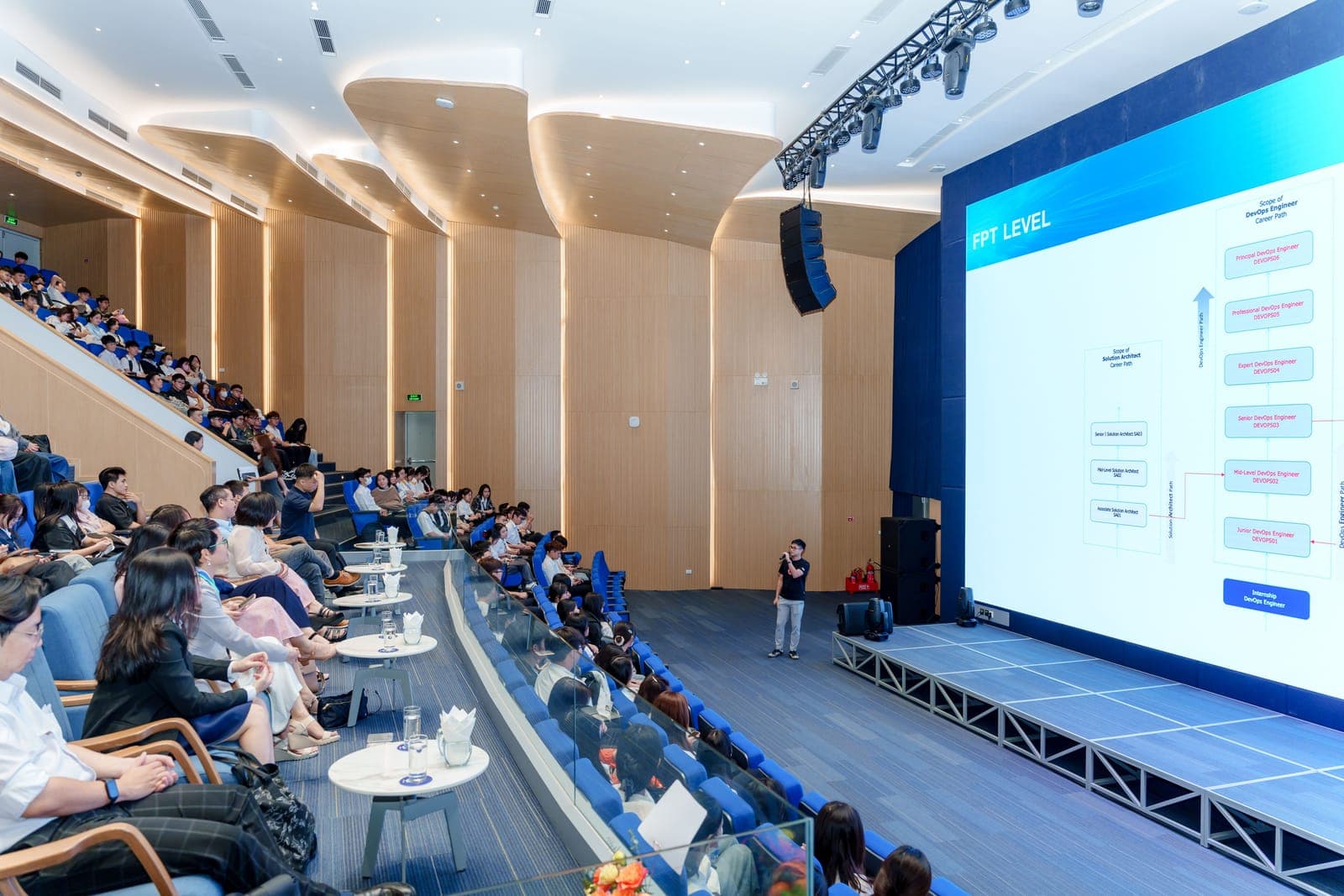

Here is what I shared with them:
1. Roadmap: DEV 1 → DEV 6
One of the slides I showed was the developer career path at FPT Software — from DEV 1 all the way to DEV 6.
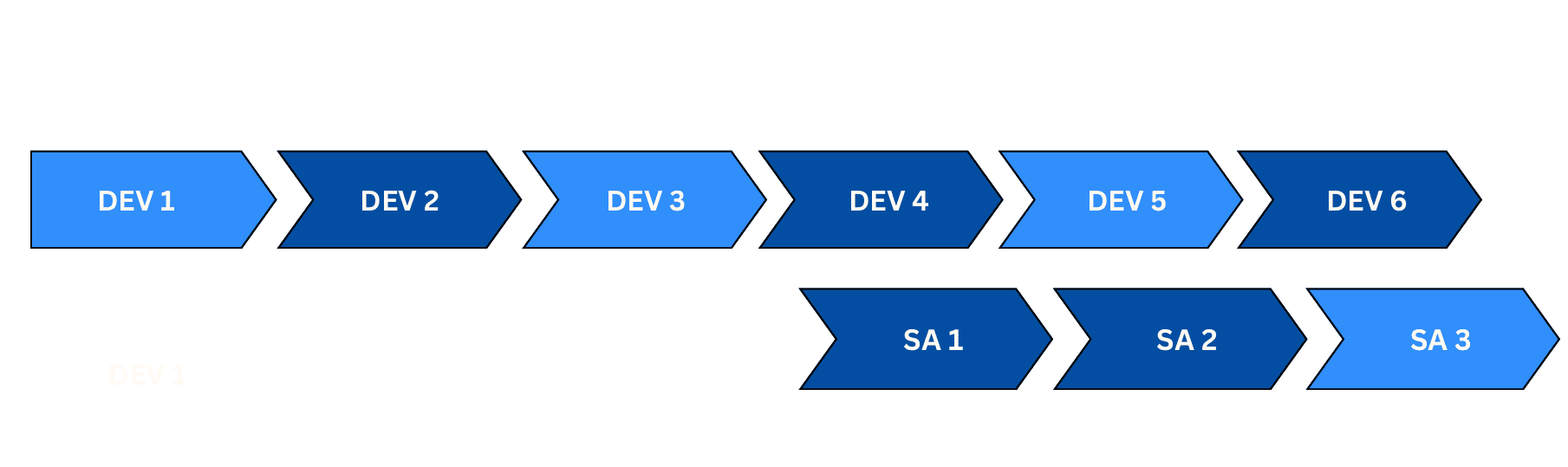
Software Developer Track at FSOFT
🟢 Junior Developer
- DEV 1 — Handles simple tasks under direct guidance and support.
- DEV 2 — Takes on medium-complexity tasks independently; handles difficult tasks with minimal support.
🔵 Senior Developer
- DEV 3 — Handles complex tasks without any support. Can own an entire module within a system.
🟣 Associate Tech Lead
- DEV 4 — Owns an entire project with multiple modules of moderate complexity. At this level, developers can choose to switch to the Solution Architect (SA) track.
🟠 Tech Lead
- DEV 5 — Owns an entire project with highly complex modules. Begins participating in solution consulting and medium-difficulty bidding activities.
🔴 Senior Tech Lead
- DEV 6 — Involved in multiple complex projects. Experienced in consulting on complex, large-scale solutions. (There is no DEV 7 at FSOFT.)
The SA Track (Branch from DEV 4)
Starting from DEV 4, developers who prefer architecture over team leadership can transition to the Solution Architect track:
SA 1 → SA 2 → SA 3 (equivalent to DEV 6)
2. The Rule of 3: Mechanism of Learning
I also shared a concept about how our brain processes information. For knowledge to move from short-term to long-term memory, it needs to be repeated at least 3 times.
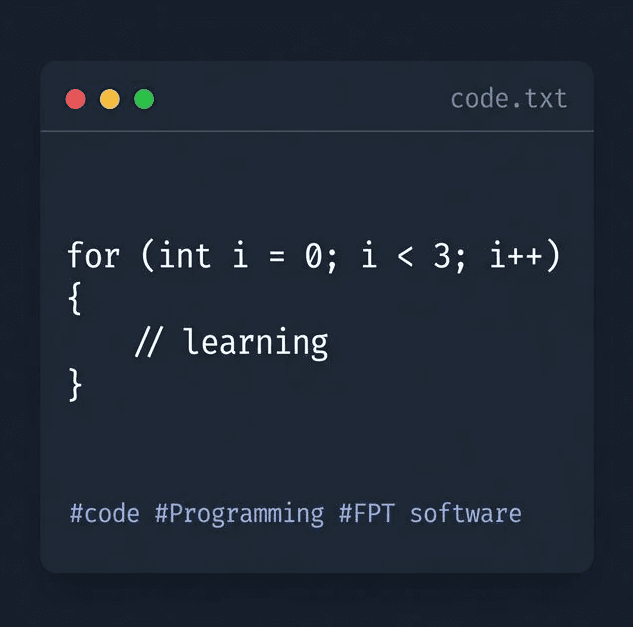
To master any subject, I suggested a 3-step loop:
- Pre-study: Read the material before coming to class.
- Engage: Listen to the lecture and take notes in class.
- Review: Re-read and practice the material after returning home.
By the time you finish the 3rd step, the knowledge has a much higher chance of sticking.
3. The Formula of Consistency
To wrap up, I wanted to show the power of consistent effort over time.
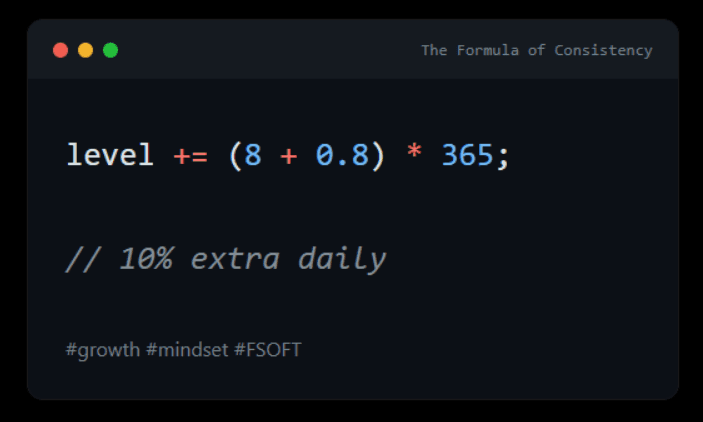
This formula illustrates a simple truth: if you commit to improving yourself by just a little bit every day (even 10%), the compound effect over a year is massive.
It's not about making huge leaps overnight, but about showing up and doing the work, day after day. That's how you bridge the gap between where you are and where you want to be.
4. The Attitude Formula
Skills help you succeed, but effort and attitude help you succeed more.
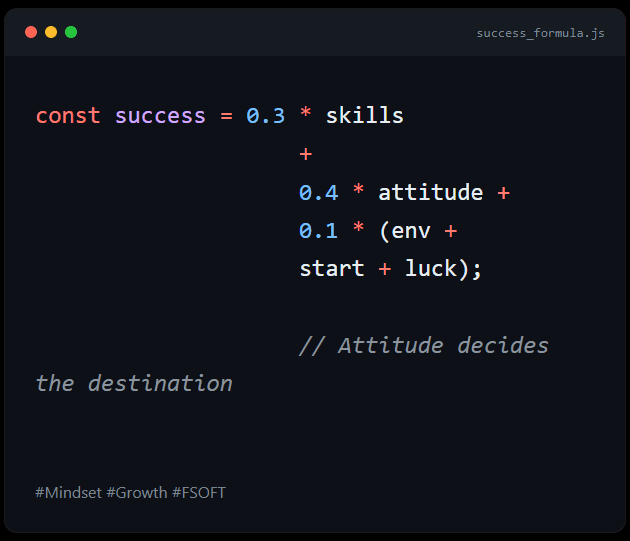
What it means:
30% comes from skills Your knowledge, technical ability, and experience matter — but they are not everything.
40% comes from attitude (effort and mindset) — this is the biggest factor. Your discipline, persistence, willingness to learn, and how hard you try make the greatest difference.
The remaining 30% comes from external factors — things you cannot fully control:
— Environment (family, school, workplace)
— Starting point (background, resources)
— Luck (opportunities, timing)

5. Other Key Takeaways
— English is a Survival Tool.
— Don't Just Code. Solve Problems.